2. Functional OCaml
OCaml is a dialect of the ML programming language family, originally developed at INRIA in France. The features of ML include:
- First-class functions: Functions are treated as values. They can be passed as arguments to other functions and returned as results.
- Immutability by default: Variables are typically assigned once, encouraging a functional style of programming.
- Algebraic data types and pattern matching: These provide expressive and concise ways to define and manipulate structured data.
- Type inference
- OCaml is statically typed, but there is no need to write type annotations explicitly.
- The language supports parametric polymorphism, similar to Generics in Java, templates in C++
- Exceptions
- Automatic garbage collection
Many ideas from functional programming have since influenced modern programming languages, including first-class and anonymous functions, as well as automatic memory management through garbage collection.
2.1 Books
Below is a list of free online books available on OCaml.
- Developing Applications with Objective Caml https://caml.inria.fr/pub/docs/oreilly-book/ocaml-ora-book.pdf
- Introduction to the Objective Caml Programming Language http://courses.cms.caltech.edu/cs134/cs134b/book.pdf
- Real World OCaml 2nd Edition https://dev.realworldocaml.org/
- OCaml from the Very Beginning https://johnwhitington.net/ocamlfromtheverybeginning/mlbook.pdf
- Cornell cs3110 book https://cs3110.github.io/textbook/cover.html is another course which uses OCaml; it is more focused on programming and less on PL theory than this class is.
- ocaml.org is the home of OCaml for finding downloads, documentation, etc. The tutorials are also very good and there is a page of books.
- OCaml exercises
2.1.1 Similar Courses
If you’re interested, I’ve listed several similar courses from other universities. For example, Cornell offers a comparable course—CS 3110—and there are also similar offerings from the University of Washington, Princeton, Harvard, and UIUC. You can check out their websites; Cornell’s, in particular, provides an online textbook along with videos and other helpful resources.
You might find it helpful to watch their lectures, go through their examples, or even try out their projects or exams. They all use OCaml, and the course structure is quite similar.
So, it’s more than just a textbook—you have access to notes, slides, exams, and other useful materials.
- CS3110 (Cornell)
- CSE341 (Washington)
- 601.426 (Johns Hopkins)
- COS326 (Princeton)
- CS152 (Harvard)
- CS421 (UIUC)
2.2 Installing OCaml
ocaml --versionThe OCaml toplevel, version 5.4.12.3 OPAM: OCaml Package Manager
Opam is the package manager for OCaml. It manages libraries and different compiler installations. For the class projects, you should install the following packages with opam.
- ounit, a testing framework similar to minitest
- utop, a top-level interface
- dune, a build system for larger projects
dune --version3.23.12.4 Running OCaml Programs
You can compile OCaml programs with either the bytecode compiler (ocamlc) or the native-code compiler (ocamlopt). The -o option specifies the output file name.
ocamlc -o main main.mlocamlc -c compiles the source file without linking and produces .cmo (compiled object) and .cmi (compiled interface) files. ocamlopt produces .cmx files, which contain native code: faster, but not platform-independent (or as easily debugged)
ocamlopt -o main main.mlYou can also run an OCaml program directly using the OCaml interpreter (ocaml). This is similar to running a Python program.
ocaml main.mlThis will run the OCaml program main.ml.
2.5 Building Projects with dune
ocamlc is convenient for compiling a single OCaml file. However, for class projects you will use dune, the build system. Dune automatically discovers dependencies and invokes the compiler and linker for you. Let us create a new project using dune:
dune init project HelloWorldSuccess: initialized project component named HelloWorldtree HelloWorldHelloWorld├── bin│ ├── dune│ └── main.ml├── dune-project├── HelloWorld.opam├── lib│ └── dune└── test ├── dune └── test_HelloWorld.ml4 directories, 7 files
# Build the projectcd HelloWorlddune build
# Run the projectdune exec bin/main.exe # OR "_build/default/bin/main.exe"
# AND/OR run the testsdune runtest
2.6 OCaml Basics
OCaml files are written with a .ml extension. There is no special main function. An OCaml file consists of:
- A series of open statements for including other modules
- A series of declarations for defining datatypes, functions, and constants
- A series of (though often just one) toplevel expressions to evaluate.
(* A small OCaml program *)print_string "Hello world!\n";;Hello world!- : unit = ()
Or
open Printf let message = "Hello world";; (printf "%s\n" message);;val message : string = "Hello world"Hello world- : unit = ()
The first line includes the built-in library for printing, which provides functions similar to fprintf and printf from stdio.h in C. The next two lines define a constant named message, and then call the printf function with a format string (where %s means “format as string”), and the constant message we defined on the line before.
To compile and run shell
ocamlc hello.ml -o hello./helloHello world!We can also compile multiple files to generate a single executable.
(* main.ml *)let main () = print_int (Util.add 10 20); print_string "\n"let () = main ()(* util.ml *)let add x y = x + yCompile and run:
ocamlc util.ml main.ml -o mainOr compile separately:
ocamlc -c util.mlocamlc util.cmo main.mlIt generates an executable main. We can execute it by:
shell ./main302.7 OCaml toplevel, a REPL for OCaml
We will begin exploration of OCaml in the interactive top level. A top level is also called a read-eval-print loop (REPL) and it works like a terminal shell. To run the ocaml toplevel, simply run ocaml
ocamlOCaml version 5.4.0(* Must close function calls with ;; to run it *)# print_string "Hello world!\n";;Hello world!- : unit = ()(* Load a .ml file into the top level *)# use "hello.ml";;Hello world!- : unit = ()
To exit the top-level, type ^D (Control D) or call exit 0;;.
There is an alternative toplevel called utop. It is more user friendly, and we will be using utop in the class. You can install utop by running opam install utop. Follow the instructions in the project 0 for installing opam and ocaml.
2.8 First OCaml Example
(* A small OCaml program (* with nested comments *) *) let x = 37;; let y = x + 5;; print_int y;;val x : int = 37val y : int = 4242- : unit = ()
OCaml comments start with (* and end with *). Comments can be nested. OCaml is strictly typed. It does not implicitly cast types. For example, print_int only prints int.
print_int 10;;10- : unit = ()
The unit = () is the return value of the print_int function. () is called unit. It is similar to void in other languages. It means the print_int function returns nothing. The following expressions do not type check
print_int 10.5;;Line 1, characters 10-14:1 | print_int 10.5;; ^^^^Error: The constant 10.5 has type float but an expression was expected of type int
because print_int does not take float as an argument.
The following code does not typecheck because + operator requires both operands to be integers. Adding a float to an integer results in a type error.
1 + 0.5;;Line 1, characters 4-7:1 | 1 + 0.5;; ^^^Error: The constant 0.5 has type float but an expression was expected of type int
Adding a boolean to an integer results in a type error too.
1 + true;;Line 1, characters 4-8:1 | 1 + true;; ^^^^Error: The constructor true has type bool but an expression was expected of type int
And as expected, print_int does not take a string as an argument.
print_int "This function expected an int";;Line 1, characters 10-41:1 | print_int "This function expected an int";; ^^^^^^^^^^^^^^^^^^^^^^^^^^^^^^^Error: This constant has type string but an expression was expected of type int
2.9 Expressions
In OCaml, expressions are the fundamental building blocks of programs, and evaluating an expression always produces a value. Unlike many imperative languages, which distinguish between statements (actions) and expressions (values), OCaml is expression-oriented—almost everything in the language is an expression that yields a result.
Every kind of expression has syntax and semantics. Semantics include:
- Type checking rules (static semantics): produce a type or fail with an error message
- Evaluation rules (dynamic semantics): produce a value or an exception or infinite loop. Evaluation rules are used only on expressions that type-check
We use metavariable e to designate an arbitrary expression.
2.10 Values
A value is an expression that is final. For example, 34 and true are values because we cannot evaluate them any further. On the contrary, 34+17 is an expression, but not a value because we can further evaluate it. Evaluating an expression means running it until it is a value. For example 34+17 evaluates to 51, which is a value. We use metavariable v to designate an arbitrary value.
2.11 Types
Types classify expressions. It is the set of values an expression could evaluate to. Examples include int, bool, string, and more. We use metavariable t to designate an arbitrary type. Expression e has type t if e will (always) evaluate to a value of type t. For example 0, 1, and -1 are values of type int while true has type bool. 34+17 is an expression of type int, since it evaluates to 51, which has type int. We usually write e : t to say e has type t. The process of determining e has type t is called type checking simply, typing.
2.12 If expression
The syntax of the if expression is
if e1 then e2 else e3We type check the if expression using the following type checking rules:
This format is called inference rules. It is a formal way to express how you can derive a conclusion from premises. They’re everywhere in logic, type systems, and formal proofs. Visually, an inference rule looks like this:
- Premises (top part) — things you already know or assumptions.
- Conclusion (bottom part) — what follows logically from the premises.
- The line separates what’s assumed from what’s derived.
In plain English, it reads: In context Γ (Γ, “Gamma”, is the type environment. It is a map of variables and their types.), if e1 has type bool, and e2 has type t, and e3 has (the same) type t then the expression if e1 then e2 else e3 has type t.
- Condition must be a
bool: The expressione1(the condition) must have typebool. For example, writingif 1 then …causes a type error, since1has typeint, notbool. - Then- and Else-branches must have the same type: Both
e2ande3must evaluate to values of the same type.
if 7 > 42 then "hello" else "goodbye";;- : string = "goodbye"The following expression does not type check because the two branches of the if expression do not return the same type. The true branch returns string, while the false branch returns int.
if 7 > 42 then "hello" else 10;;Line 1, characters 28-30:1 | if 7 > 42 then "hello" else 10;; ^^Error: The constant 10 has type int but an expression was expected of type string
Evaluating an if expression returns a value. For example:
if 10 > 5 then 100 else 200;;- : int = 100if 10 < 20 then 1 else 2if 10 > 20 then print_int 102.13 Functions
OCaml functions are like mathematical functions. They compute a result from provided arguments. We use let to define a function:
We now define the function next, which accepts an integer n and produces its successor.
let next n = n + 1;; next 10;; (* call the function next with an argument 10 *)val next : int -> int = <fun>- : int = 11
Here is another function Factorial:
let rec fact n =  if n = 0 then    1  else    n * fact (n-1);;
fact 5;;
val fact : int -> int = <fun>- : int = 120
rec keyword is used to define recursive functions. ;; ends an expression in the top-level of OCaml. We use it to say: “Give me the value of this expression”. It is not used in the body of a function and it is not needed in the real OCaml development.
Quiz: Quiz: Write a function sum that takes a positive integer n and returns the value of 1+2+3+…n.
let rec sum n = if n = 1 then 1 else n + sum (n-1);; sum 10;;val sum : int -> int = <fun>- : int = 55
2.13.1 Calling Functions (Function Application)
In OCaml, calling a function is very straightforward — you just write the function name followed by its arguments, separated by spaces (not commas, and no parentheses are required unless for grouping). The calling syntax is:
f e1 e2 … enHere is an example where we call the function square with the argument 5.
let square x = x * x;;square 5;;val square : int -> int = <fun>- : int = 25
Nullary functions (Functions with no arguments) are a little special compared to languages like C or Python. OCaml does not truly have “argument-less” functions. Instead, a nullary function is defined as one that takes the special value () of type unit.
let greet () = "Hello";;greet ();;val greet : unit -> string = <fun>- : string = "Hello"
We evaluate a function call expression according to these steps:
- Locate the definition of f, i.e.,
let rec f x1 … xn = e. - Evaluate the arguments
e1 … ento obtain valuesv1 … vn. - Substitute the values
v1 … vnfor the parametersx1 … xnin the function bodye, yielding a new expressione'. - Evaluate
e'to valuev, which is the final result
Following is an example of evaluating fact 2
let rec fact n = if n = 0 then 1 else n * fact (n-1);;val fact : int -> int = <fun>| Expression | Semantics |
|---|---|
fact (1+1) | evaluate the argument 1+1 |
fact 2 | substitute every occurrence of n inside the body of fact with 2 |
if 2=0 then 1 else 2*fact(2-1) | evaluate the if expression |
2 * fact 1 | result of the else branch |
2 * (if 1=0 then 1 else 1*fact(1-1)) | substitute n with 1 |
2 * 1 * fact 0 | evaluate fact 0 |
2 * 1 * (if 0=0 then 1 else 0*fact(0-1)) | base case |
2 * 1 * 1 | |
2 |
let rec mystery n m = if n > m then 0 else n + mystery (n+1) m;;mystery 5 10;;2.13.2 Function Types
In OCaml, → is the function type constructor. Type t1 → t is a function with argument or domain type t1 and return or range type t. Type t1 → t2 → t is a function that takes two inputs, of types t1 and t2, and returns a value of type t.
(* function add takes two integer arguments and returns an integer value *)let add x y = x + y;;val add : int -> int -> int = <fun>(* function greet takes a unit and returns a unit *)let greet () = print_string "What's up?";;val greet : unit -> unit = <fun>2.14 Type Checking of Function Application
As we have seen before, the syntax of a function application is
f e1 … enWe use the following type checking rule for a single argument function application
It reads: if f has type t1 → t2 and e has type t1, then f e has type t_2.
In general, we use the following type checking rule for a function application:
It reads: if f : t1 → … → tn → u and e1 : t1, …, en : tn then the type of f e1 … en is u.
For example: the type of not true is bool because not : bool → bool and true : bool.
not;;true;;not true;;- : bool -> bool = <fun>- : bool = true- : bool = false
Another example: the type of (+) is int → int → int, the type of 1+2 and 3*4 are int. Therefore, the type of (+) (1+2) (3 * 4) is int.
(+);; (* int -> int -> int *)(1+2);; (* int *)(3*4);; (* int *)(+) (1+2) (3*4);; (* int *)(1+2) + (3*4);; (* int *)- : int -> int -> int = <fun>- : int = 3- : int = 12- : int = 15- : int = 15
2.14.1 More Examples on Function Type Checking
As illustrated by the preceding examples, OCaml does not require programmers to explicitly annotate types as in languages such as C or Java. Instead, OCaml employs the Hindley-Milner type system to automatically infer the types of expressions before performing type checking.
For example, the following function double multiplies its integer argument by two:
let double x = x * 2;;val double : int -> int = <fun>OCaml infers the type of double as int → int as follows: the operator * denotes integer multiplication, so both of its operands must have type int. Therefore, x must have type int. Consequently, both the parameter type and the return type of double are int. In other words, double is a function that takes an int as input and returns an int as output.
let double x = x * 2;;double 10;;val double : int -> int = <fun>- : int = 20
Calling double with an argument of a different type results in a type-checking error.
let double x = x * 2;;double 10.5;;val double : int -> int = <fun>Line 1, characters 8-12:1 | double 10.5;; ^^^^Error: The constant 10.5 has type float but an expression was expected of type int
The function add takes three integers as arguments, computes their sum, and returns an integer result.
(* Adding three integers *)let add x y z = x + y + z;;val add : int -> int -> int -> int = <fun>The function fn takes a floating-point value as its argument, converts it to an integer, multiplies it by 3, and returns an integer result.
let fn x = (int_of_float x) * 3;;fn 2.5;;val fn : float -> int = <fun>- : int = 6
In OCaml, int_of_float converts a floating-point value (float) to an integer (int).
int_of_float 3.7;; (* = 3 *)int_of_float 3.0;; (* = 3 *)int_of_float (-3.7);; (* = -3 *)- : int = 3- : int = 3- : int = -3
The following are more examples in which OCaml infers the type of a function:
(* Greatest Common Divisor of Two Positive Integer Numbers *)let rec gcd a b = if b = 0 then a else gcd b (a mod b);; (* mod: int → int → int. It implies a and b must be int. The return type is int because it returns a *)val gcd : int -> int -> int = <fun>(* Sum of the first n natural numbers *)let rec sum n = if n = 0 then 0 else n + sum (n-1);;(* n=0 implies n must be int. Return type is int because it returns 0 in one branch. *)val sum : int -> int = <fun>(* Prime Factors of a Given Positive Integer *)let rec aux d n = if n = 1 then [] else if n mod d = 0 then d :: aux d (n / d) else aux (d + 1) n;;let factors n = aux 2 n;;factors 210;;val aux : int -> int -> int list = <fun>val factors : int -> int list = <fun>- : int list = [2; 3; 5; 7]
2.14.2 Mutually Recursive Functions
Mutually recursive functions are functions that call each other (directly or indirectly). You define them using the and keyword along with let rec.
Suppose we want two functions, even and odd, to determine whether a number is even or odd, with even calling odd and odd calling even. We define them together using let rec … and …
let rec odd n = if n = 0 then false else even(n-1) and even n = if n = 0 then true else odd(n-1);;even 100;;odd 101;;val odd : int -> bool = <fun>val even : int -> bool = <fun>- : bool = true- : bool = true
2.14.3 Polymorphic Types
In OCaml, a polymorphic type is a type that contains one or more type variables (written ‘a, ‘b, etc.), meaning the function or value can operate uniformly on values of many different types. A polymorphic function works for any type, not just one specific type. The following functions swap and eq are polymorphic functions. The types ‘a and ‘b can be read as for all types a and b
(* Swap the elements of a tuple (we will cover tuples later) *)let swap (x, y) = (y, x);;val swap : 'a * 'b -> 'b * 'a = <fun>The function eq x y returns true if x and y are structurally equal, and false otherwise. It has type 'a -> 'a -> bool, meaning that for any type 'a, it takes two values of type 'a and produces a boolean result.
(* structural equality *)let eq x y = x = y;;eq 3 3;; (* true *)eq 1 2;; (* false *)eq "hello" "hello";; (* true *)eq [1;2] [1;2];; (* true *)eq [1;2] [2;1];; (* false *)eq "hello" 1;; (* type error *)val eq : 'a -> 'a -> bool = <fun>- : bool = true- : bool = false- : bool = true- : bool = true- : bool = falseLine 1, characters 12-13:1 | eq "hello" 1;; (* type error *) ^Error: The constant 1 has type int but an expression was expected of type string
The types 'a 'b are basically generic types in Java. The Java version of the eq is:
public static <T> boolean eq(T x, T y) { return x.equals(y);}let f x y = if x = y then 1 else 0;;2.14.4 Type annotations
The OCaml compiler can infer types automatically, but type inference can be tricky and sometimes produces vague error messages. To avoid this, we can provide type annotations manually. Annotations are useful for clarity, documentation, and resolving ambiguities.
let (x : int) = 3;;val x : int = 3let fn (x:int):float = (float_of_int x) *. 3.14;;(* (x : int) explicitly states that x is an integer. float states the return type is float *)let add (x:int) (y:int):int = x + y;;val fn : int -> float = <fun>val add : int -> int -> int = <fun>
let id x = x;;val id : 'a -> 'a = <fun>let id (x:int) = x;;(* This annotation constrains the function to take an int as its argument and to return an int. *)val id : int -> int = <fun>2.15 Lists
The list is a fundamental data structure in OCaml. Lists can have arbitrary length and are implemented as linked structures. All elements in a list must be of the same type (i.e., lists are homogeneous). We will learn how to construct lists and deconstruct them using pattern matching. In OCaml, [ ] is a value, represents an empty list. Elements are separated by semicolons.
[];;[1; 2; 3; 4];;["apple"; "banana"; "cherry"];;- : 'a list = []- : int list = [1; 2; 3; 4]- : string list = ["apple"; "banana"; "cherry"]
To evaluate [e1; e2;…;en], we evaluate e1 to a value v1, e2 to a value v2, and en to a value vn, and return [v1;…;vn].
In OCaml, the list notation [e1; e2] is syntactic sugar for using the cons operator :: (pronounced “cons”). :: constructs a list by prepending an element to an existing list. Specifically:
[e1; e2];; (* syntactic sugar *)e1 :: e2 :: [];; (* desugared form *)let y = [1; 1+1; 1+1+1] ;;let x = 4::y ;;let z = 5::y ;;let m = "hello" :: "bob" ::[];;val y : int list = [1; 2; 3]val x : int list = [4; 1; 2; 3]val z : int list = [5; 1; 2; 3]val m : string list = ["hello"; "bob"]
2.15.1 Typing Lists
The type of an empty list [ ] is 'a list. The type of Cons is
It reads: if e1 : t and e2 : t list then (e1::e2) : (t list).
let l = [];;let m = [[1];[2;3]];;let w = ["apple"; "banana"; "watermelon"];;val l : 'a list = []val m : int list list = [[1]; [2; 3]]val w : string list = ["apple"; "banana"; "watermelon"]
let y = 0::[1;2;3];;val y : int list = [0; 1; 2; 3]let x = [1;"world"] ;; (* all elements must have same type *)Line 1, characters 11-18:1 | let x = [1;"world"] ;; (* all elements must have same type *) ^^^^^^^Error: This constant has type string but an expression was expected of type int
[1.0; 2.0; 3.0; 4.0]10::[20]let f x = x :: [\"hello\"];;2.15.2 :: Operator
The :: operator prepends a single item, not a list, to the front of another list. The left argument of :: is an element, the right is a list
let y = 0::[1;2;3] ;;let w = [1;2]::y ;; (* error *)val y : int list = [0; 1; 2; 3]Line 1, characters 16-17:1 | let w = [1;2]::y ;; (* error *) ^Error: The value y has type int list but an expression was expected of type int list list Type int is not compatible with type int list
Quiz: Quiz: What is the type of the following expression?
Yes. If the type of y is int list list, i.e., [1;2]::[[3;4]]. Each element of this list is an int list.
let y = [[3;4;5];[6]];;[1;2]::y;;val y : int list list = [[3; 4; 5]; [6]]- : int list list = [[1; 2]; [3; 4; 5]; [6]]
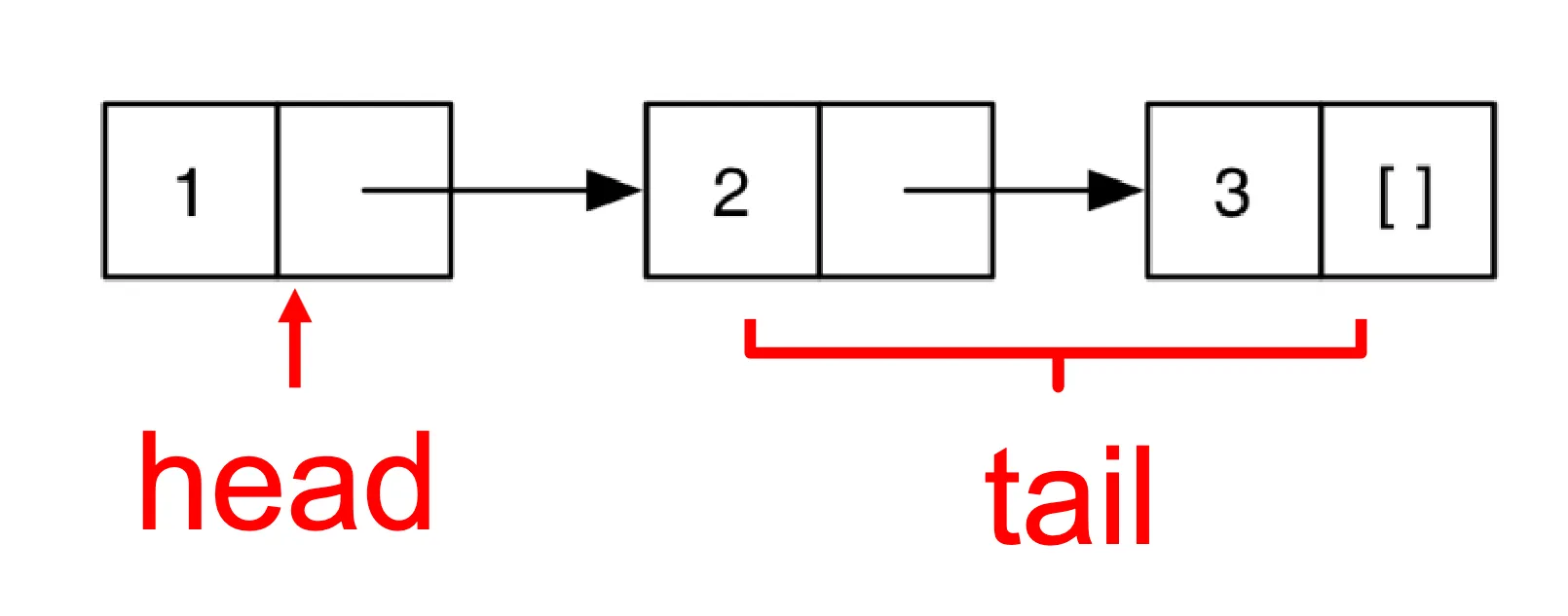
A nonempty list is a pair (element, rest of list). The element is the head of the list, and rest of the list is itself a list. Thus in math (i.e., inductively) a list is either
- The empty list
[ ] - Or a pair consisting of an element and a list
This recursive structure will come in handy shortly. [1;2;3] is represented as:
2.15.3 Lists of Lists
Lists can be nested arbitrarily. For example:
[ [9; 10; 11]; [5; 4; 3; 2] ];;- : int list list = [[9; 10; 11]; [5; 4; 3; 2]]The type int list list can also be written as (int list) list.
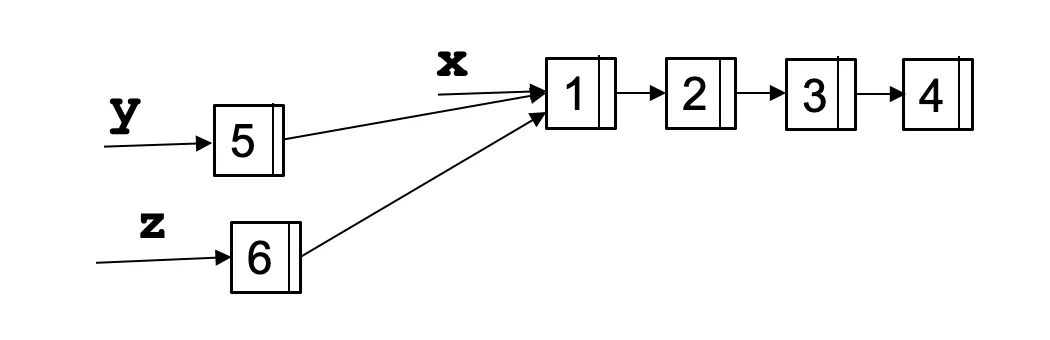
Lists are immutable in OCaml; you cannot change an element of a list. Instead, you create new lists from existing ones, for example using the :: operator.
let x = [1;2;3;4];;let y = 5::x;;let z = 6::x;;val x : int list = [1; 2; 3; 4]val y : int list = [5; 1; 2; 3; 4]val z : int list = [6; 1; 2; 3; 4]
Since x refers to an immutable list, the tails of both y and z share the same list x.
2.16 Pattern Matching
Pattern matching in OCaml is a powerful way to destructure values, test their shape, and bind variables to parts of the value — all in a single, concise construct. It is used extensively with algebraic data types (like option, list, trees, and custom types).
The syntax of the match expression is:
match e with| p1 -> e1| …| pn -> en